
A Single Mom, Two Kids, and an FHA Loan: How Danielle Bought Her First Home in Puyallup
Reviewed by Peter Irungu, NMLS #2751063 | Last updated October 23, 2026
Danielle called me on a Wednesday evening in July. She'd just put her two kids to bed in the two-bedroom apartment they'd been sharing since her divorce 18 months earlier. Her voice was quiet but determined: 'I'm tired of my kids sharing a room. I'm tired of paying someone else's mortgage. But I don't know if I can do this on one income.'
She made $78,000 a year as a medical billing specialist. She had $9,000 saved. Her credit score was 671. On paper, she looked like a lot of single parents I talk to capable, hardworking, and convinced that homeownership was a luxury reserved for two-income households.
It isn't. Here's how Danielle bought a three-bedroom home in Puyallup's South Hill neighborhood with an FHA loan, $9,000 in savings, and a monthly payment she could actually afford.
The Number That Changed Everything
Danielle assumed she needed $60,000 or more for a down payment the 20% she'd always heard about. On a $400,000 home, that's $80,000. She didn't have it, and she didn't think she'd have it for years.
I showed her the real numbers. An FHA loan requires 3.5% down. On a $400,000 home, that's $14,000. On the $385,000 home she eventually bought, it was $13,475. That's the number that changed the conversation from 'someday' to 'let's start.'
Her $9,000 in savings didn't cover the full down payment plus closing costs but it didn't need to. Washington's down payment assistance programs and seller credits could close the gap. The first step wasn't saving more. It was understanding what she actually needed.
The Credit Score She Didn't Know She Had
Danielle's credit score was 671 better than she thought. After her divorce, she'd worried that the joint accounts and the financial upheaval had tanked her credit. In reality, she'd kept up with every payment, and her score had recovered nicely.
What we found was one issue: a credit card from the marriage that her ex was supposed to close but never did. It had a small balance and a late payment from eight months earlier. We disputed it, and within three weeks, her score jumped to 698 enough to qualify her for a better rate.
If you're coming out of a divorce and assuming your credit is damaged, check before you assume. You may be in better shape than you think and even if you're not, a few targeted fixes can make a real difference.
Using Down Payment Assistance as a Single Parent
Danielle's $9,000 covered about $13,475 of her down payment, but she still needed roughly $9,500 for closing costs. That's where Washington's Home Advantage down payment assistance program came in.
The program provided a second mortgage of about $11,500 (3% of her first loan amount) that covered her closing costs and left a small reserve. The DPA loan is deferred she doesn't make monthly payments on it, and it's repaid when she sells, refinances, or pays off the first mortgage.
For a single parent whose budget is already tight, the deferred structure matters. Danielle wasn't adding another monthly payment to her budget. She was getting help with upfront costs that would have otherwise kept her renting for another year or more.
The Home That Felt Right
Danielle found a three-bedroom ranch in South Hill Puyallup listed at $389,000. It had a fenced backyard for her kids, a garage for her car, and a kitchen she could actually picture herself cooking in. She offered $382,000 with a request for $6,000 in seller credits toward closing costs.
The seller countered at $385,000 with $4,000 in credits. Danielle accepted. The appraisal came in at $388,000. The inspection found a furnace nearing the end of its life we negotiated another $2,500 in credits to address it.
Her monthly payment including principal, interest, property taxes, and insurance: $2,710. Her rent had been $1,950. The difference was $760 per month but she was building equity, her kids had their own rooms, and the payment was locked in. Rent was only going to go up.
Closing Day and What Came After
Danielle closed 41 days after her offer was accepted. Her total out-of-pocket at closing: about $1,800 the gap between her savings, the DPA, and the seller credits. She walked into her first home with her savings mostly intact.
I got a photo from her a week after closing. Her kids were sitting on the living room floor, surrounded by boxes, eating pizza on paper plates. The caption: 'Our first night in OUR house.'
If you're a single parent in Pierce County wondering whether you can do this on one income, the answer is probably yes. It takes a clear plan, the right loan program, and a willingness to start the conversation. I'll help you with the first two. The third part is up to you.
All loan products, interest rates, and terms are subject to credit approval and market conditions. This is not a commitment to lend. Down payment assistance programs have income and eligibility requirements. Programs, rates, terms, and conditions are subject to change without notice.
Have questions about your mortgage?
Book a free 15-minute call with Peter no credit pull required.
Related Articles
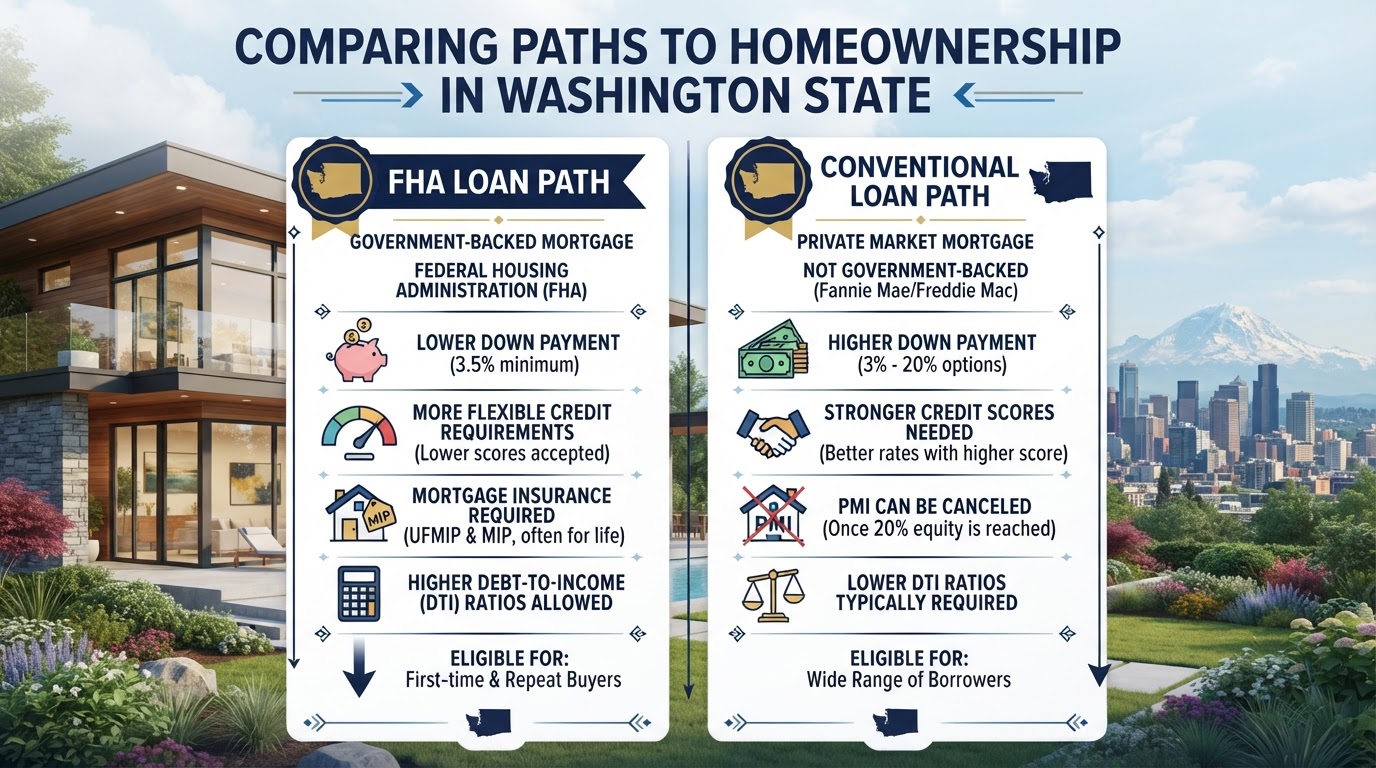
FHA vs Conventional Loans in Washington State: Which Is Right for You?
Comparing down payments, mortgage insurance, credit requirements, and costs to help Washington buyers choose between FHA and conventional financing.

7 First-Time Homebuyer Mistakes to Avoid in Washington State (And How to Dodge Them)
From underestimating closing costs to skipping the pre-approval, here are the most common first-time buyer mistakes in Washington and exactly how to avoid each one.

Condo vs. House in Washington: Which Is the Smarter First Purchase?
HOA fees, appreciation, maintenance, and lifestyle the real pros and cons of buying a condo versus a single-family home for Washington first-time buyers.